
Two Calendars and a Clock
An Exercise in Alternative Chronometry

The three systems collected here are personal timekeeping instruments conceived as aesthetic objects and constructed for the pleasure of their making and the altered perception of their use. I consider alternative chronometry to be a form of art, much like conlanging or conworlding or alt-history exploration, albeit a nascent one, whose possibilities have scarcely been delimited.
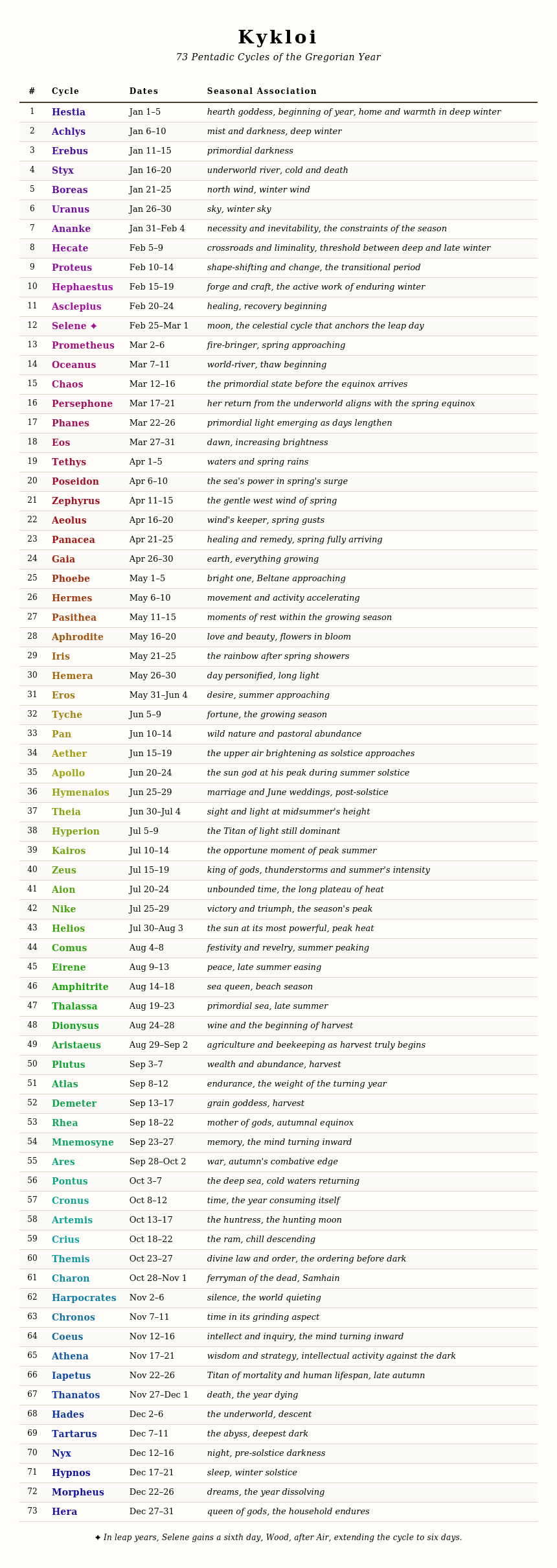
Kykloi
The Kykloi Calendar is a pentadic overlay on the Gregorian calendar, designed as a personal timekeeping system rather than a civil reform proposal. The year is tiled by 73 five-day cycles (from the Ancient Greek κῠ́κλοι kykloi, singular κῠ́κλος kyklos), each named for a Greek deity. Days within each cycle are named for classical elements in fixed order: Aether, Fire, Earth, Air, Water, a sequence derived from the ordering Fire-Earth-Air-Water in Hellenistic astrology, with Aether, Aristotle's "first" element, prepended. For example, the Pan cycle (June 10–14) runs as follows: Aether of Pan (June 10), Fire of Pan (June 11), Earth of Pan (June 12), Air of Pan (June 13), Water of Pan (June 14).
Years begin on Aether of Hestia (January 1) and end on Water of Hera (December 31). Days begin at midnight.
The Selene cycle absorbs the Gregorian leap day: in leap years, a sixth day, Wood (木 mù, an element from the Chinese wuxing), is inserted after Air, making the cycle six days long (February 25 through March 1).
Dates may be written as Element of Deity, Year (Earth of Rhea, 2024), as day/cycle (3/53), or expanded with year (3/53/2024).
The rationale behind the Kykloi Calendar is that the pentad provides a more useful planning increment than the week: five days is short enough that the end stays visible from the beginning, and 73 cycles per year means each one is low-stakes enough to fail and reset. Naming cycles for deities rather than numbering them gives each interval a distinct character, so that a cycle functions as a bounded unit with an identity rather than an arbitrary span of dates. The element sequence reinforces orientation within the cycle, with Aether as beginning, Earth as midpoint, and Water as close. Each deity was selected and placed for its seasonal associations.
Jongleur's Calendar
Green apples redshift as the jongleur juggles them, falling back and springing forward in his hands: apple, appulle, aplaz, he chants
The Jongleur's Calendar is a polyrhythmic timekeeping system constructed from three concurrent cycles of lengths 8, 13, and 21, which are consecutive Fibonacci numbers. The cycles run concurrently, each advancing by one position per day, and the conjunction of all three produces a unique three-word name for every day within a 2,184-day period. The epoch (i.e., calendrical inception) is the vernal equinox, March 20, 2024, smiling wild riddle.
The Three Cycles
The three cycles are called the Red Apples, the Green Apples, and the Blue Apples, corresponding to cycle-lengths of 8, 13, and 21, respectively. Each cycle advances by one position per day, cycling through a fixed sequence of distinct names:
Red Apples (8 words): smiling, painted, floating, hidden, brachiating, anastomosing, grooved, pigmented
Green Apples (13 words): wild, electromechanical, aleatoric, lucky, blue, crystalline, ancient, fluorescent, peaceful, melodic, gnarly, brittle, metaphysical
Blue Apples (21 words): riddle, butterfly, lantern, zithers, orrery, chalices, quincunx, gem, scroll, parasol, mirror, chimes, pagoda, coin, garden, rainbow, cookies, conch, kettle, orchid, prisms
On any given day, the calendar reads one word from each list: March 20, 2024 is smiling wild riddle, March 21 is painted electromechanical butterfly, March 22 is floating aleatoric lantern, etc. The Red Apples cycle back to smiling after 8 days, the Green Apples to wild after 13, and the Blue Apples to riddle after 21. Because these periods are incommensurate, the three cycles phase in and out of alignment like a polyrhythm, and the same three-word combination does not recur for 2,184 days.
Finding Any Date
To find any date, calculate the number of days between the epoch and the target date (timeanddate.com makes this easy). Divide that number by 8, by 13, and by 21, and note all three remainders. Each remainder tells you how many positions to count from the epoch's starting name in that cycle: smiling for Red, wild for Green, riddle for Blue. Count forward for dates after the epoch, but backward for dates before.
For example, February 25, 1986 is 13,903 days before the epoch. 13,903 mod (modulo, i.e., the remainder after division) 8 = 7 (count backward 7 positions from smiling to reach painted). 13,903 mod 13 = 6 (count backward 6 positions from wild: fluorescent). 13,903 mod 21 = 1 (count backward 1 position from riddle: prisms). This indicates that February 25, 1986 corresponds to painted fluorescent prisms.
Similarly, February 25, 2025 is 342 days after the epoch. 342 mod 8 = 6 (count forward 6 positions from smiling to arrive at grooved). 342 mod 13 = 4 (count forward 4 positions from wild: blue). 342 mod 21 = 6 (count forward 6 positions from riddle: quincunx). The result is therefore grooved blue quincunx.
Mathematics
The cycle lengths 8, 13, and 21 are the 6th, 7th, and 8th Fibonacci numbers, a sequence in which each number is the sum of the two before it.
A key property of this calendar is that all three cycle lengths are pairwise coprime, meaning any two of them share no common factors (i.e., their greatest common divisor, or gcd, is 1). Consecutive Fibonacci numbers are always coprime, so gcd(8, 13) = 1, and gcd(13, 21) = 1. The non-adjacent pair, 8 and 21, are also coprime (2³ vs. 3 × 7).
The Chinese Remainder Theorem (CRT) is a result in number theory which states that given a set of pairwise coprime moduli, any combination of remainders corresponds to exactly one value within the product of those moduli. The consequence of the CRT for this calendar is that given any combination of a Red position, a Green position, and a Blue position, exactly one day within the 2,184-day cycle has that combination. Every possible three-word name therefore occurs exactly once per cycle, and none are skipped.
The full period is the least common multiple (lcm) of the three cycle lengths: lcm(8, 13, 21) = 2,184 days, approximately 5.978 years. Because this is not a whole number of years, the calendar drifts against the Gregorian calendar, with the result that a given three-word name will not fall on the same Gregorian date twice within a single cycle.
The White Apples
The full 2,184-day period is called the White Apples cycle. White is a nonspectral color, since it has no wavelength of its own and cannot be found on the rainbow. It exists only as a perceptual synthesis, the brain's response to all channels arriving together. The White Apples cycle is analogous in that it does not belong to any single primary cycle, but emerges from all three phasing back into alignment.
The three-word name of a day repeats every White Apples cycle. To specify a unique date, append the White Apple number, in the form of "White Apple N". For instance, the cycle containing the epoch is White Apple 0. Cycles after the epoch are positive, while cycles before are negative. Our paradigmatic date, February 25, 1986 is painted fluorescent prisms, White Apple -7; the epoch itself is smiling wild riddle, White Apple 0. March 13, 2030 is smiling wild riddle, White Apple 1, the first recurrence of the epoch name, seven days shy of its Gregorian anniversary.
The three-word name is the cyclic identity of a day, whereas the White Apple number is the linear identity. Together they locate any day in history uniquely.
The Secondary Cycles
When two of the three primary cycles realign, the result is a shorter composite cycle. These are named in accordance with additive color mixing:
Yellow Apples (Red + Green): lcm(8, 13) = 104 days. The interval after which the same pair of words from the Red and Green lists coincides again.
Magenta Apples (Red + Blue): lcm(8, 21) = 168 days. The pairing of non-adjacent Fibonacci numbers, whose coprimality is not guaranteed by adjacency but holds because 8 and 21 share no prime factors.
Cyan Apples (Green + Blue): lcm(13, 21) = 273 days. The two larger, adjacent Fibonacci numbers, whose sub-cycle is the longest of the three pairings.
Interestingly, each secondary cycle fits into the White Apples cycle a whole number of times, and that number is always the Fibonacci number not involved in the pairing: Yellow (Red + Green) fits 21 times, Magenta (Red + Blue) fits 13 times, and Cyan (Green + Blue) fits 8 times.
Mesoamerican Parallels
The White Apples cycle is structurally equivalent to the Calendar Round, a dating system that combines two independent calendars, in Mesoamerican timekeeping. The Maya tzolkʼin (the 260-day sacred calendar) is itself a two-cycle system of a 13-number cycle and a 20-day-name cycle running simultaneously, producing 260 unique day-names. The tzolkʼin then meshes with the 365-day haabʼ calendar to produce the Calendar Round, which repeats every lcm(260, 365) = 18,980 days, approximately 52 years. The Aztec system works identically, with the tōnalpōhualli (the Aztec equivalent of the tzolkʼin) and xiuhpōhualli (their 365-day solar calendar) combining to produce a 52-year cycle called the xiuhmolpilli, the binding of the years.
In both the Mesoamerican systems and the Jongleur's Calendar, independent cycles of different lengths run like concurrent polyrhythms, and the long-cycle is the interval after which all rhythms coincide again. The Jongleur's Calendar uses three cycles rather than two, and Fibonacci numbers rather than the Mesoamerican 13, 20, and 365, but the underlying principle is the same: the long-cycle is the least common multiple of all the constituent periods, and the dayname is the conjunction of positions across all cycles.
Etymology
A note on the name: the word "juggler" derives from "jongleur", and the calendar is named for the older word deliberately. But the jongleur's repertoire extended well beyond juggling, as jongleurs were the itinerant performers of medieval Europe, and their primary art was the recitation of poetry and song. The name carries both senses: the juggling of three concurrent cycles, and poetry.

A spreadsheet with date names extending fifty years before and after the epoch is available here.
Icosatime
A Vigesimal Circadian Clock
Icosatime is a base-20 timekeeping system that divides the day into uniform vigesimal tiers: 20 icosahours, each containing 20 icosamaximes, each containing 20 icosaminutes, each containing 20 icosaseconds, each containing 20 icosasemiseconds. This five-tier hierarchy produces a total resolution of 3.2 million icosasemiseconds per day. In practice, the four-digit display stops at the icosasecond, yielding 160,000 ticks per day at approximately 0.54 conventional seconds each, roughly the duration of a heartbeat.
Notation
Time is written in H_MN_S format: one digit for the icosahour, two for the icosamaxime and icosaminute, and one for the icosasecond. An alphanumeric scaffold uses 21 symbols (0 through 9 and A through J) in standard base-20 positional notation, where 0=0, 9=9, A=10, J=19, and 20 rolls over to 10. So a reading like I_49_G means 18 icosahours, 4 icosamaximes, 9 icosaminutes, 16 icosaseconds (or equivalently, 18 icosahours, 89 icosaminutes, 16 icosaseconds, since the two middle digits can be read as a single vigesimal number: 4×20 + 9 = 89).
But the alphanumeric layer is scaffolding. The primary notation is hieroglyphic, with twenty Egyptian hieroglyphs serving as the digit set, chosen for visual distinctness, mutual interdistinguishability, and iconic Egyptian identity. The symbols function as positional markers, like compass points or chess coordinates, rather than as numerals with intrinsic quantitative meaning. Some assignments are mnemonic (Sun for zero, Obelisk for one, Two Reeds for two, Pyramid for three visible sides, Star for five points, Scarab for six legs, Cat for nine lives), but the rest are arbitrary.
The full glyph table:
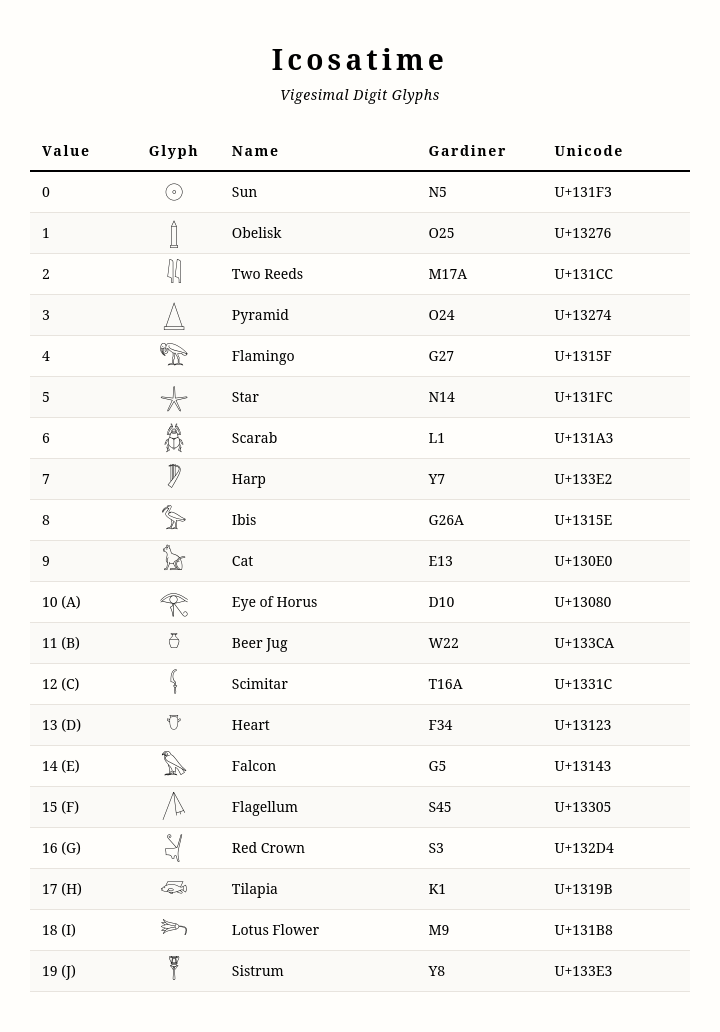
A time reading on the clock face is four hieroglyphs: for example, 𓅞_𓆣𓃠_𓋔 (Ibis_Scarab·Cat_Red Crown), which in alphanumeric H_MN_S notation is 8_69_G.
The Epoch
An "epoch" is the fixed reference point from which a timekeeping system begins counting.
The epoch of icosatime (𓇳_𓇳𓇳_𓇳, or Sun_Sun·Sun_Sun) is fixed at a single historical moment: the temporal midpoint between sunrise and solar zenith on the vernal equinox of March 20, 2026, calculated at 45°N latitude and Sedona, Arizona's longitude (approximately 111.761°W). Ephemeris computation using PyEphem places this moment at 16:29:53 UTC, which corresponds to 9:29:53 AM MST.
The choice of 45°N is geometrically motivated: on the equinox at that latitude, the sun reaches exactly 45° elevation at noon, perfectly bisecting the sky between horizon and zenith. The choice of Sedona's longitude fixes the epoch to a particular moment in local solar time there, with every other location's Sun_Sun·Sun_Sun offset by longitude, so the clock resets at roughly 9:30 AM local solar time everywhere, rather than at the same UTC moment everywhere. As the inventor's (yours truly's) favorite author, Tom Robbins, wrote in "Honky-Tonk Astronaut" (Wild Ducks Flying Backwards): "I'm just a loner from Sedona, Arizona, the center of the known universe."
Icosazones
Twenty icosatime zones, or icosazones, of 18° longitude each divide the globe, replacing the conventional 24 time zones of 15° each. The reference zone, Sun Zone (𓇳), is centered on Sedona's longitude, and the remaining 19 zones radiate eastward at 18° intervals, each named for its corresponding hieroglyphic digit. The zone index is the offset; for example, Scarab Zone (6) is always exactly 6 icosahours ahead of Sun Zone.
Representative cities by zone:
𓇳 Sun: Sedona, Phoenix, Los Angeles, Denver, Las Vegas, Salt Lake City
𓉶 Obelisk: Chicago, Dallas, Mexico City, Houston, Minneapolis
𓇌 Two Reeds: New York, Washington DC, Miami, Toronto, Lima, Bogotá
𓉴 Pyramid: Buenos Aires, Halifax, Montevideo, San Juan
𓅟 Flamingo: São Paulo, Rio de Janeiro, Recife, Brasília
𓇼 Star: Reykjavik, Dakar, Cape Verde, Azores
𓆣 Scarab: London, Paris, Madrid, Lisbon, Dublin, Accra
𓏢 Harp: Berlin, Rome, Stockholm, Vienna, Prague, Oslo
𓅞 Ibis: Cairo, Istanbul, Moscow, Athens, Nairobi, Jerusalem, Kyiv
𓃠 Cat: Baghdad, Riyadh, Dubai, Tehran, Doha, Tbilisi
𓂀 Eye of Horus: Mumbai, Karachi, Delhi, Islamabad, Yekaterinburg
𓏊 Beer Jug: Kolkata, Dhaka, Kathmandu, Bangalore, Chennai
𓌜 Scimitar: Bangkok, Singapore, Jakarta, Hanoi, Kuala Lumpur
𓄣 Heart: Beijing, Shanghai, Hong Kong, Seoul, Taipei, Manila
𓅃 Falcon: Tokyo, Osaka, Vladivostok, Melbourne, Guam
𓌅 Flagellum: Sydney, Brisbane, Magadan
𓋔 Red Crown: Auckland, Wellington, Fiji
𓆛 Tilapia: Honolulu, Samoa
𓆸 Lotus Flower: Anchorage, Fairbanks, Tahiti
𓏣 Sistrum: San Francisco, Seattle, Vancouver, Juneau
Borderline Cities
Several major cities sit close enough to an icosazone boundary that political or cultural affinity might reasonably pull them into an adjacent zone.
Guangzhou is the most extreme case, lying 0.02° from the Heart/Scimitar boundary – it technically falls in Heart alongside Hong Kong and Shenzhen, but a rounding error in longitude data could place it in Scimitar with Bangkok and Singapore. Delhi (0.03° from the Eye of Horus/Beer Jug line) barely lands within Eye of Horus, while Bangalore, only three degrees east, falls within Beer Jug, splitting India's two major tech cities across icosazones. Athens (0.49°) technically belongs to Ibis with Cairo, but sits right at the Harp boundary where Rome and Berlin live, raising the question of whether the birthplace of Western civilization aligns east or west. Amsterdam and Brussels technically fall within Scarab alongside London, while Marseille lands just across the line in Harp with Berlin, with all three within half a degree of the boundary. The Pacific Northwest coast (San Francisco, Seattle, Portland) falls just outside Sun Zone into Sistrum Zone, so the zone that contains Sedona does not quite reach the California coast.
Mathematics
Subdivisions and Self-Similarity
Because each unit is always divided into 20 of the next smaller unit, the same fractional relationships hold at every tier of the hierarchy.
Half an icosahour (which contains 20 icosamaximes) is Eye of Horus (10) icosamaximes. Half an icosamaxime (which contains 20 icosaminutes) is Eye of Horus (10) icosaminutes. Half an icosaminute is Eye of Horus (10) icosaseconds. The same glyph appears in the same fractional position at every level of magnification: just as a half of any unit is always Eye of Horus of the next tier down, a quarter is always Star (5), a fifth is always Flamingo (4), and a tenth is always Two Reeds (2).
Fractions whose denominators divide 20 – halves, quarters, fifths, tenths – land on an exact whole number in a single chronometric tier: a half of an icosahour is exactly 10 icosamaximes, a quarter is 5, a fifth is 4 – and these same ratios hold at every tier. Compound fractions from these factors also land cleanly in one tier: a fifth of a quarter is 1 icosamaxime (a quarter is 5, a fifth of 5 is 1). Fractions whose denominators divide 400 but not 20 – eighths, sixteenths, twenty-fifths – require two tiers to resolve: an eighth of an icosahour is exactly 50 icosaminutes (2 icosamaximes and 10 icosaminutes), and a sixteenth is 25 icosaminutes. 1/32 of any icosaunit will equal a whole number of icosaunits three tiers down. Every fraction whose denominator is built from powers of 2 and 5 eventually lands cleanly; it just needs enough tiers.
Thirds never terminate, instead repeating forever in vigesimal as they do in decimal. This is not a coincidence: since 10 and 20 share the same prime factorization (2 and 5, differing only in multiplicity), the set of terminating fractions in vigesimal is identical to the set in decimal.
Unit Conversion in Decimal Notation
Converting between icosatime tiers when working in decimal notation exploits the factorization 20 = 2 × 10. To convert into smaller units, multiply along successive powers of 2 (2, 4, 8, 16, 32...) and shift the decimal the corresponding number of places to the right; to convert into larger units, shift the decimal to the left and divide along the same successive powers of 2. One tier up or down: respectively divide or multiply by 2, shift one place; two tiers: divide/multiply by 4, shift two; three tiers: divide/multiply by 8, shift three; four tiers: divide/multiply by 16, shift four.
For example: 118.23 icosahours → icosasemiseconds (four tiers down). 118.23 × 16 = 1,891.68, shift four places right → 18,916,800 icosasemiseconds. In reverse: 18,916,800 icosasemiseconds → icosahours. Shift four places left → 1,891.68, divide by 16 → 118.23 icosahours. The trick works because 20ⁿ = 2ⁿ × 10ⁿ: the multiplication handles the factor of 2, the decimal shift handles the factor of 10.
Unit Conversion in Pure Vigesimal Notation
In pure vigesimal notation, even the divide/multiply-and-shift decomposition becomes unnecessary. Multiplying by 20 in base 20 is moving the radix point one place, just as multiplying by 10 in base 10 is a decimal shift.
Take the reading 𓅞_𓆣𓃠_𓋔 (alphanumerically, 8 6 9 G). These are four vigesimal digits. Where you place the radix point determines the unit:
8.69G → icosahours. 86.9G → icosamaximes. 869.G → icosaminutes. 869G → icosaseconds.
The digits are invariant; only the radix point moves. This is the same principle by which 1.500 kilometers equals 1,500 meters.
This works in reverse: 7C4B icosaseconds becomes 7C4.B icosaminutes, 7C.4B icosamaximes, or 7.C4B icosahours by shifting left. Duration addition composes naturally with shifting. Add Pyramid·Sun and Obelisk·Eye of Horus icosaminutes digit by digit to get Flamingo·Eye of Horus icosaminutes. Shift left and it becomes Flamingo.Eye of Horus icosamaximes – four and a half, since Eye of Horus = 10 = half of 20.
Shifting works because the ratio between adjacent tiers is always 20. The five tiers of icosatime are not five different units in the way that hours, minutes, and seconds are different units; they are five magnification levels on the same number.
J's Complement
J's complement (a vigesimal analog of the 9's complement) is a way to perform subtraction without borrowing. To find the complement of any reading, subtract each of its four digits independently from J (i.e., Sistrum, or 19). For example, the complement of 3_55_2 is G_EE_H, because J−3=G, J−5=E, J−5=E, J−2=H.
The complement tells you how much time remains in the day: 3_55_2 + G_EE_H = J_JJ_J, the last tick before rollover, and this is true for any reading and its complement.
Digit-Readable Divisibility
As in decimal, the last digit of any vigesimal number reveals divisibility by factors of the base. In icosatime, this means any duration's last glyph tells you instantly whether it splits evenly into 2, 4, 5, or 10 parts, which is useful for scheduling and time-bracketing. Notably, vigesimal gives you divisibility by 4 from the last digit alone, which decimal requires two digits to determine.
Historical Context
No natural pure vigesimal circadian timekeeping system is known to exist.
The closest precedents are the Mesoamerican vigesimal calendars. The Maya Long Count, for example, structures its day-count in vigesimal tiers: the kʼin (1 day), the winal (20 kʼin = 20 days), the tun (18 winal = 360 days), the kʼatun (20 tun = 7,200 days), and the bʼakʼtun (20 kʼatun = 144,000 days). The critical irregularity occurs at the tun, where the multiplier drops from 20 to 18 to approximate the 365-day solar year. Above the tun, pure vigesimal returns, but this break means the Long Count is a modified vigesimal system, not a pure one.
The Aztec system was parallel: the tōnalpōhualli ("count of days") was a 260-day sacred calendar cycling 20 named day signs against the numbers 1 through 13, and the xiuhpōhualli ("count of years") was a 365-day solar calendar. Like the Maya tun, the xiuhpōhualli uses 18 groups of 20 days rather than 20 groups of 20, breaking vigesimal purity to approximate the solar year.
In all cases, the Mesoamerican systems applied their vigesimal arithmetic to counting days, rather than to subdividing a day. Other cultures with vigesimal counting traditions (Inuit, Ainu, Basque, Georgian, various West African language groups) likewise never applied base-20 to timekeeping.
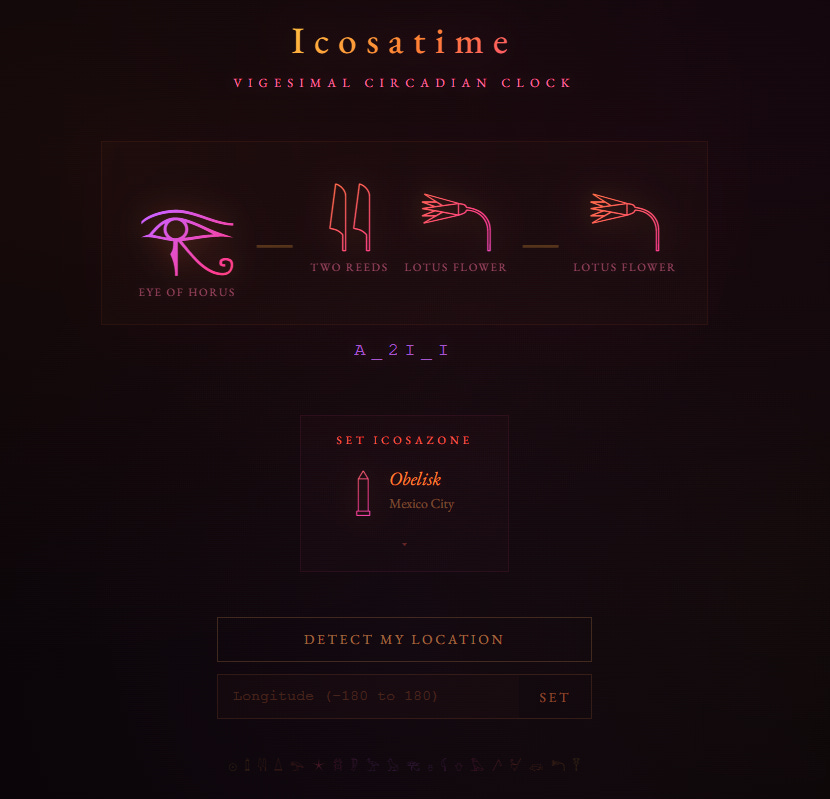
A live version of the clock is hosted here.
Coda
As I compose this article, the day is Aether of Phoebe, brachiating crystalline cookies, and the time reads Scarab_Lotus Flower · Tilapia_Red Crown on a clock face of rainbow sunset-hued hieroglyphics stochastically swirled with iridescence. None of this information is currently practical outside of the admittedly limited scope of my life, but all of it makes the day richer and more enlivening.
I enjoy how you preserve the ancient insight where time is not just a series of quantities but also contain qualities captured in the names of animals as well as divine personifications.
wonderful work!